how to determine what usb drive protocol is using
USB Operation: Protocol, Data Transfer & Packets
USB, Universal Serial Jitney has a divers protocol for the data transfer using a variety of specific types of data packets for its operation.
USB Universal Serial Bus Includes:
USB introduction USB standards Connectors, pinouts & cables Information transfer & protocol USB iii USB-C USB hubs How to purchase best USB hub
USB, Universal Serial Bus is very easy to use providing a reliable and constructive ways of transferring data. Whether USB 1, USB two, USB 3 or even USB iv, the data requires a standardised method of transfer over the USB interface along with a standard format for the USB information packets.
To achieve this the arrangement has a defined the USB data transfer protocol, information packet format, etc that enables the data to be formatted and carried in a divers way that provides the reliable communication. The bus likewise operates in a item fashion, seeing the various devices fastened to information technology independently of the actual physical layout of the system.
Although some changes have been fabricated betwixt the different updates to the USB standard every bit information technology progressed from USB 1 to USB 2, USB 3, and USB 4, the basic operation, protocol, signalling and information transfer modes, data packet format, etc are basically the aforementioned.
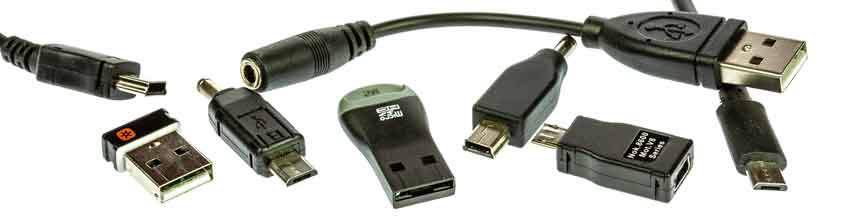
USB operational basics
In guild to understand how the information transfers and the protocol operates within the USB environment, it is first necessary to empathise how USB is physically fix and how it appears to the arrangement / host.
For virtually systems using USB, the host will be some form of computer: desktop, laptop, tablet, etc, although this does not e'er demand to be the case.
In terms of the definitions of the entities in a USB network, there are three main elements:
-
Host: The host is the computer or item that acts equally the primary element or controller for the USB system. The host has a hub independent within it and this is called the Root Hub.
-
Hub: The hub is a device that finer expands the number of ports bachelor - information technology will have ane connection tot he upstream connection, and several downstream. Information technology is possible to plug 1 hub into another to expand the capability and connectivity further.
-
Port: This is the socket through which access to the USB network is gained. It can be on a host, or a hub.
-
Role: These are the peripherals or items to which the USB link is connected. Mice, keyboards, Flash memories, etc, etc.
-
Device: This term is collectively used for hubs and functions.
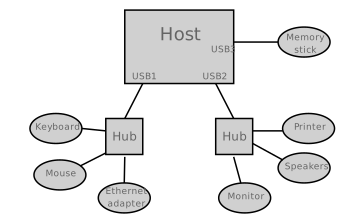
The physical layout of a USB 'network' may consist of the host with ii (for example) ports and each of these may have a hub fastened, to which farther devices or 'functions' are attached.
The actual physical layout of the USB system will vary co-ordinate to the bodily situation, but the functioning is always basically the aforementioned.
In terms of the data flow, the signals travel along the bus so that it is accessibly by all the functions, but only the destination part accepts it.
Selecting USB role destination
With data for all devices beings ent forth the motorbus, information technology is necessary for the USB operation that the data is only accepted by the required function.
To achieve this, when a device is attached to the jitney information technology is assigned a unique number or accost by the host for the time it is connected.
In addition to the address, the device also contains endpoints. These are the bodily sources and destinations for communications between the host and the device.
Endpoints can only operate in ane direction, i.due east. input or output, but non both, and devices tin can have upwards to 16, of which ane each for the input and output must exist reserved equally the 'Zilch Endpoint' for that management. Although each device tin have sixteen input and sixteen output endpoints, it is very rare for them all to be used.
The zero endpoints are used for a diversity of activities including automobile-detection and configuration of the device on the bus and the 2 zero endpoints are the merely ones attainable until the device is properly connected on the bus.
USB information pipes
The communication within USB is based around the concept of using data pipes. These can be considered as being logical channels inside the data flow on the autobus.
In reality, a USB data pipage is a connectedness from the host controller to a logical entity within a device, i.e. the endpoint. Because pipes correspond to endpoints, the terms are sometimes used interchangeably.
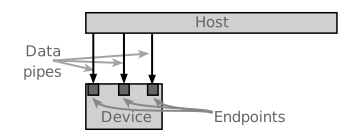
The host and then uses the concept of a data piping to ensure the data to and from a device is correctly directed or the source is known. The information piping uses a combination of the address, endpoint and also the direction to ascertain it.
To communicate with the zero endpoints a special form of information pipe is needed because information technology needs to be used to found the initial communication. It is called the Default Control Pipage and it can be used when the initial concrete connection is fabricated.
There are two types of USB pipe:
- Message Pipage : This type is a bi-directional USB piping and it is used for command data. Message pipes are typically used for short, uncomplicated commands to the device, and for status responses from the device. They can be used by the bus control pipe number 0.
- Stream Pipe: This grade of USB pipe is uni-directional and it is connected to a uni-directional endpoint that transfers data using an isochronous, interrupt, or bulk transfers (run into below).
USB signalling and data transfer basics
For USB 1 and 2 a 4 wire arrangement is employed. As detailed elsewhere, the cables bear: power, footing and then in that location is a twisted pair for the differential data transfer.
The lines are designated Data+, D+ and Information-, D- for USB 1 and USB ii. For USB 3, new lines were introduced. For each port there are TX1+ & TX1- and TX2+ & TX2- to embrace the transmitted data and then for the received data the lines are RX1+ & RX1- and RX2+ & RX2-.
The utilise of twisted pairs and differential signalling reduces the effects of external interference that may picked upwards. It also reduces the consequence of any hum loops, etc that could crusade issues. As it is not related to ground, but the difference betwixt the two lines, the effects of hum are significantly reduced
The information uses an NRZI organization, i.e. non-return to zero.In terms of operation, when the USB host powers upwards, information technology polls each of the slave devices in turn.
The USB host has address 0, and so assigns addresses to each device likewise as discovering the slave device capabilities in a process chosen enumeration. [Enumeration takes place when a new device is connected].
Transactions between the host and device incorporate a number of packets. As there are several unlike types of data that tin can be sent, a token indicating the type is required, and sometimes an acknowledgement is as well returned.
Each packet that is sent is preceded by a sync field and followed by an end of package marker. This defines the start and end of the package and too enables the receiving node to synchronise properly and then that the diverse date elements fall into identify.
At that place are iv basic types of information transaction that can be made within USB.
- Control: This type of data transaction within the overall USB protocol is used past the host to send commands or query parameters. The package lengths are defined within the protocol every bit 8 bytes for Depression speed, 8-64 bytes for Full, and 64 bytes for High Speed devices.
- Interrupt: The USB protocol defines an interrupt message. This is often used by devices sending pocket-sized amounts of data, due east.1000. mice or keyboards. It is a polled message from the host which has to asking specific data of the remote device
- Bulk: This USB protocol message is used by devices like printers for which much larger amounts of data are required. In this class of information transfer, variable length blocks of data are sent or requested past the Host. The maximum length is 64-byte for full speed Devices or 512 bytes for high speed ones. The data integrity is verified using cyclic redundancy checking, CRC and an acknowledgement is sent. This USB data transfer machinery is not used by time disquisitional peripherals because it utilises bandwidth not used past the other mechanisms.
- Isochronous: This grade of data transfer is used to stream existent fourth dimension data and is used for applications like live sound channels, etc. Information technology does not utilise and data checking, as in that location is not time to resend any data packets with errors - lost information can be accommodated meliorate than the delays incurred by resending data. Packet sizes can be up to 1024 bytes.
The information transfer methodology and protocol for USB provides an effective method of transferring the data beyond the interface in an effective and reliable style.
USB data packets
Inside the USB system, at that place are four different types of information packets each used for unlike types of data transfer.
-
Token Packets: Substantially a Token USB data package indicates the type of transaction is to follow.
-
Data Packets: The USB data packets carry the payload information, carrying the data every bit required.
-
Handshake Packets: The handshake packets are used acknowledging data packets received or for reporting errors, etc.
-
Start of Frame Packets: The Offset of Frame packets used to betoken the start of a new frame of data.
Although USB has developed from USB 1 through USB 2 to USB 3 and at present USB 4, information technology still utilises the aforementioned basic approach to data transfer. In that location are many USB connectors and leads bachelor, and these leads at present have many more wires for higher rate information transfer. Accordingly the data transfer speeds take increased many fold over the first USB specification that was released and the devices that were available.
Wireless & Wired Connectivity Topics:
Mobile Communications basics 2G GSM 3G UMTS 4G LTE 5G WiFi IEEE 802.15.iv DECT cordless phones NFC- Near Field Communication Networking fundamentals What is the Cloud Ethernet Series information USB SigFox LoRa VoIP SDN NFV SD-WAN
Return to Wireless & Wired Connectivity
washingtonoppostis1979.blogspot.com
Source: https://www.electronics-notes.com/articles/connectivity/usb-universal-serial-bus/protocol-data-transfer.php
0 Response to "how to determine what usb drive protocol is using"
Post a Comment